The Memory Card Mistake That Can Ruin a Video Shoot
Camera rental in Lagos often starts with the exciting stuff. Which camera are we using? Should we get the FX6 or FX3? Which lens will give us the look we want? Do we need a gimbal?
Then, somewhere near the end of the conversation, someone asks, “Do we have memory cards?”
It sounds like a small question until you’re on set, the talent is ready, the lights are up, everyone has been waiting for the director, and the camera suddenly says card full. Now you’re trying to find another compatible card while the clock is running and your production budget is quietly suffering.
Memory cards aren’t the most glamorous part of filmmaking, but they are one of the easiest things to get wrong.
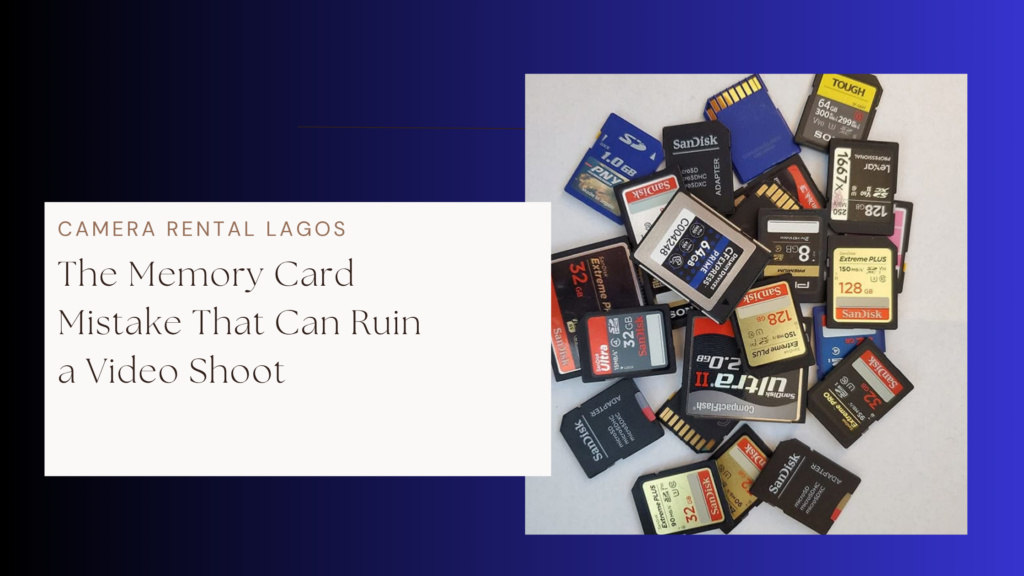
Not Every Memory Card Can Handle Every Camera
A memory card isn’t simply something you put inside a camera to save footage. Different cameras and recording formats have different media requirements.
A camera shooting high-bitrate 4K or 6K footage can write a huge amount of data to the card very quickly. A card might physically fit the camera and still not be fast enough for the recording mode you want to use. Therefore, always check what type and speed of card your camera requires before the shoot.
The One-Card Shoot Is a Risk
Here’s a scenario that happens more often than it should: a team has one large memory card because “it’s enough.”
Maybe it is enough. But what happens if the shoot runs longer than expected? What if the director wants another take? What if you capture additional B-roll? What if the card develops a problem? Suddenly, the entire production is waiting on a tiny piece of plastic.
For short shoots, one card might be manageable. For commercials, documentaries, events, interviews, or full-day productions, having additional cards gives you breathing room.
How Much Storage Does Your Shoot Need?
There isn’t a magic answer like “just get a 256GB card.” Your storage requirement depends on the camera and how you’re recording.
Resolution, bitrate, frame rate, codec, and recording time all affect how quickly your storage fills up. Shooting high-quality footage for several hours can produce a lot more data than someone recording short social media clips. For example, a production team shooting a full-day corporate documentary needs to plan storage very differently from a creator filming a 30-minute talking-head video.
The safest approach is to estimate your expected footage and then leave yourself some extra room. You don’t want your storage calculation to work perfectly on paper and fail because you needed 40 more minutes of B-roll.
Your Camera May Need a Specific Card Speed
Capacity isn’t the only thing that matters.
A 1TB card isn’t automatically better than a 256GB card if the camera requires a particular sustained write speed. High-performance cinema cameras can demand media capable of keeping up with their recording formats.
This is one reason it’s worth speaking to your rental provider before choosing your media. If you’re renting unfamiliar production gear, don’t assume the card you already own will work simply because it fits.
What Happens After the Card Is Full?
This is where storage planning becomes bigger than just memory cards.
If you’re shooting a long production, you need somewhere to put the footage once those cards start filling up. A laptop, card reader, and reliable storage drive can become just as important as the camera itself.
However, don’t rush to format a card immediately after copying the footage. First, confirm that the files transferred correctly and that you can actually open and use them. For important productions, keeping more than one copy is a much safer approach.
Don’t Wait Until Shoot Day to Figure It Out
The worst time to discover that your memory card isn’t compatible with your camera is when the camera is already on a tripod and the client is watching.
When arranging camera rental, tell the rental company what camera you’re using and what you intend to shoot. That gives the team a chance to recommend compatible media rather than leaving you to figure it out yourself.
If you’re sourcing film equipment rental in Lagos, you can check Camera Equipment Rental Lagos alongside your camera and other production gear. You can also explore Lens Rental Lagos if your project requires additional lenses.
Running Out of Storage Can Cost More Than a Memory Card
The funny thing about memory cards is that they are relatively small compared with the rest of a production budget. Yet forgetting them can create a much bigger problem.
Imagine having a crew, talent, location, makeup, lighting, and equipment booked for the day, only to lose valuable shooting time because you need to stop and source storage. In Lagos, where traffic and tight schedules can already make production logistics challenging, that’s a headache you don’t need.
For filmmakers and production companies, planning your storage alongside your camera rental in Lagos is a simple way to avoid an unnecessary production delay.
Conclusion: The Smallest Gear Can Cause the Biggest Problem
Nobody gets excited about memory cards. Nobody talks about them when describing the “cinematic look” of a production.
But when the camera is ready and there’s nowhere to record the footage, suddenly that little card becomes the most important piece of equipment on set.
Before your next camera rental in Lagos, check the camera’s media requirements, calculate how much footage you expect to capture, bring enough compatible cards, and plan where your footage will go afterwards. It is a small part of the production plan, but getting it right can save you from a very expensive problem.
If you’re unsure what storage your setup requires, contact Camera Rental Lagos before your shoot. It’s much easier to solve a storage problem before production day than when the camera is already rolling.